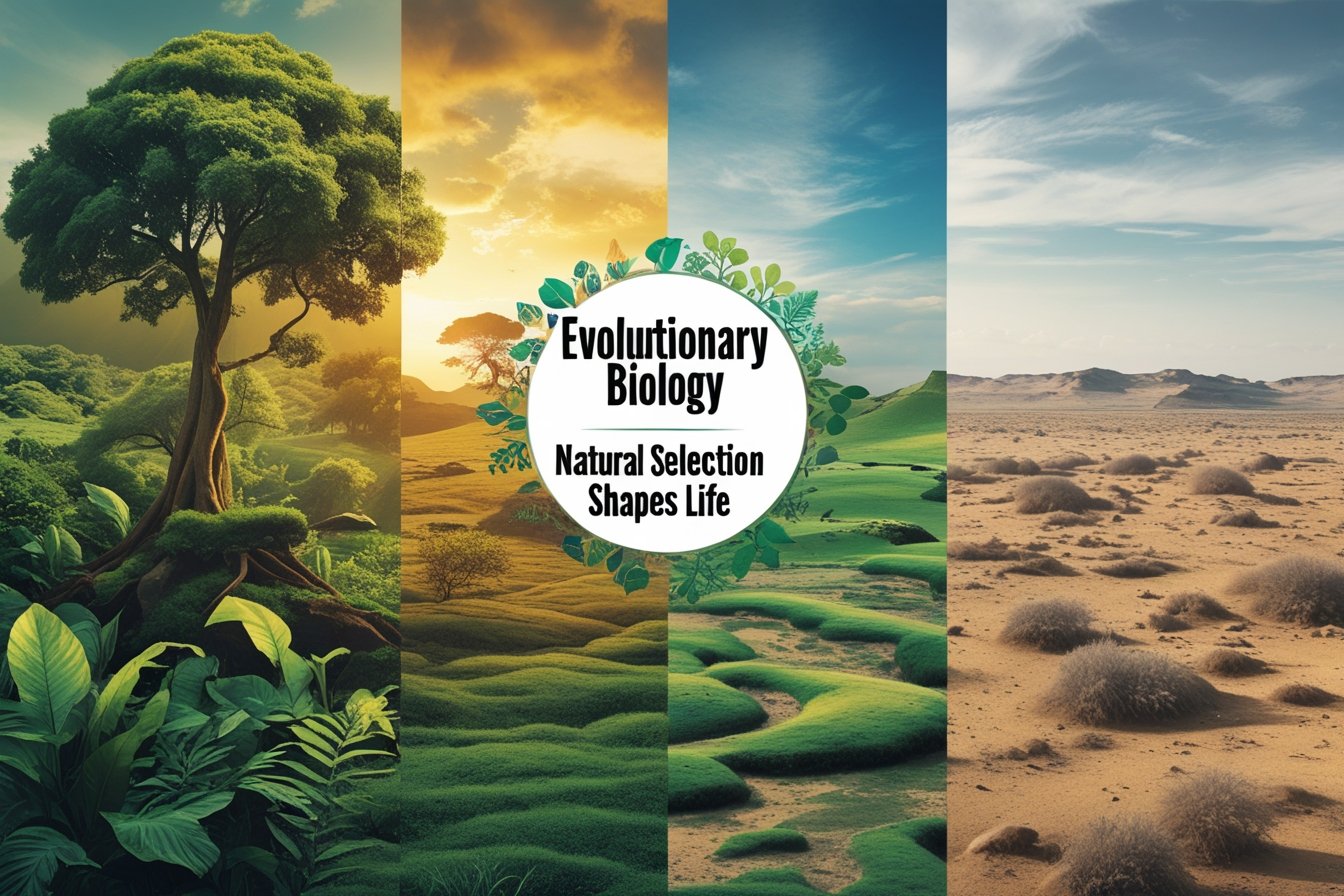
What if every breath you take, every heartbeat, and every thought represents millions of years of biological engineering? Evolutionary biology reveals that natural selection isn’t just a scientific theory, it’s the invisible architect that shapes life in ways more profound and personal than most people realize.
The Molecular Democracy of Survival:
Natural selection operates like a molecular democracy where every cell gets a vote, but only the most efficient voters survive to influence future elections. This evolutionary biology process happens at scales both microscopic and massive, creating a continuous referendum on what works and what doesn’t in the living world.
At the molecular level, natural selection shapes life through protein folding competitions, where enzymes that work faster and more accurately get copied more frequently. Your body contains thousands of these molecular success stories, proteins that won evolutionary competitions spanning millions of years.
Evolutionary biology reveals that survival isn’t about the strongest or smartest, but about the most adaptable. Organisms that are more adapted to their environment are more likely to survive and pass on the genes that aided their success. This creates a dynamic feedback loop where environmental pressures continuously refine living systems toward greater efficiency and resilience.
Genetic Architecture as Living Blueprint Systems:
Natural selection functions as the ultimate architect, constantly redesigning the genetic blueprints that shape life. Unlike human architects who work with fixed materials, evolutionary biology demonstrates how living blueprints can modify themselves based on environmental feedback and performance results.
Your DNA represents a library of architectural solutions tested across evolutionary time scales. Each gene is essentially a proven design element that has survived countless environmental challenges and reproductive competitions. Natural selection acts as both quality control inspector and innovation driver, preserving successful designs while allowing space for beneficial modifications.
Genetic architecture created by natural selection includes:
- Modular design systems: Genes that can be combined in different ways for varied functions
- Backup systems: Redundant pathways ensuring survival if primary systems fail
- Efficiency optimization: Metabolic pathways refined for maximum energy production
- Environmental sensors: Genetic switches that respond to changing conditions
This architectural approach explains why evolutionary biology produces such elegant solutions to complex survival challenges. Each organism represents millions of years of iterative design improvement guided by natural selection.
Environment as Evolution’s Kitchen:
Natural selection operates like a master chef in evolution’s kitchen, using ecological pressures as heat sources that transform raw genetic ingredients into refined survival recipes. Evolutionary biology shows us that environmental challenges don’t just threaten life, they actively shape life into more sophisticated forms.
Desert environments pressure-cook organisms toward water conservation and heat tolerance, while arctic conditions select for insulation and cold-weather metabolism. Ocean depths create pressure chambers that forge creatures capable of surviving crushing depths and eternal darkness.
These ecological pressure systems work simultaneously across multiple dimensions:
- Resource scarcity drives efficiency innovations and competitive advantages
- Predation pressure selects for defensive mechanisms, camouflage, and escape strategies
- Climate variations favor adaptability and resilience over specialization
- Social dynamics encourage cooperation, communication, and complex behavioral patterns
Natural selection uses these environmental pressures as sculpting tools, gradually carving away inefficient traits while enhancing features that improve survival odds. The result is the incredible diversity and sophistication of life we observe today.
Reproductive Strategy Gaming Theory:
Evolutionary biology reveals that reproduction involves complex game theory where different strategies compete for genetic dominance. Natural selection doesn’t just favor individual survival, it optimizes reproductive success through sophisticated genetic gaming systems.
Some species invest heavily in producing many offspring with minimal parental care, gambling that quantity will overcome individual vulnerability. Others focus on fewer offspring with intensive parenting, betting that quality and preparation will provide advantages. Natural selection shapes life by testing these different reproductive strategies against environmental challenges.
Reproductive gaming strategies include:
- Tournament competition: Males competing for mating rights through displays or combat
- Cryptic choice: Females make subtle selections that influence fertilization success
- Cooperative breeding: Groups sharing reproductive responsibilities for collective advantage
- Timing optimization: Synchronizing reproduction with optimal environmental conditions
These gaming approaches demonstrate how natural selection creates complex behavioral and physiological adaptations that maximize genetic transmission while minimizing survival costs.
Symbiotic Networks as Evolutionary Partnerships:
Natural selection increasingly favors symbiotic relationships over purely competitive approaches, creating network effects that shape life through cooperation rather than conflict. Evolutionary biology shows that the most successful organisms often achieve dominance through strategic partnerships rather than solo survival.
Your body exemplifies this symbiotic approach, you’re actually a walking ecosystem containing trillions of bacterial partners that help digest food, regulate immunity, and maintain health. Natural selection shaped these partnerships over millions of years, creating integrated systems where human and bacterial success become interdependent.
Symbiotic networks created by natural selection include:
- Mycorrhizal fungal networks connecting forest trees through underground communication systems
- Cleaning stations where fish cooperate in parasite removal partnerships
- Pollination contracts between flowering plants and insects for mutual benefit
- Gut microbiomes that process nutrients while receiving shelter and food
This partnership approach reveals how evolutionary biology increasingly rewards collaboration over competition as ecosystems become more complex and interconnected.
Natural Selection in Fast Forward:
Natural selection doesn’t always operate at geological time scales, sometimes it accelerates dramatically during crisis periods, creating rapid evolution windows that shape life within decades or even years. Evolutionary biology documents numerous cases where environmental pressure creates fast-forward evolutionary responses.
Urban environments create particularly intense natural selection pressure that drives rapid adaptation. City-dwelling animals develop different behavioral patterns, stress responses, and even physical characteristics within surprisingly short time periods. Birds change their singing frequencies to cut through urban noise, while mammals adjust their activity cycles to avoid human interference.
Rapid evolution examples include:
- Antibiotic resistance development in bacterial populations within months
- Industrial melanism in moths responding to pollution changes
- Cichlid fish speciation in isolated lakes within thousands of years
- Darwin’s finches’ beak modifications during drought periods
These rapid evolution windows demonstrate that natural selection can shape life much faster than previously understood, especially when survival pressures become intense and genetic variation provides raw material for change.
Beyond DNA Programming:
Evolutionary biology reveals that natural selection operates beyond traditional genetic inheritance through epigenetic mechanisms that can transmit environmental adaptations across generations. This discovery expands our understanding of how experience and environment shape life at the molecular level.
Epigenetic inheritance allows organisms to pass environmental adaptations to offspring without changing underlying DNA sequences. Stress responses, nutritional adaptations, and even learned behaviors can influence gene expression patterns that get transmitted to future generations.
Natural selection works through epigenetic systems by:
- Environmental memory storage: Recording survival-relevant information in gene expression patterns
- Adaptive preparation: Pre-conditioning offspring for likely environmental challenges
- Rapid response capability: Enabling quick adaptation without waiting for genetic mutations
- Reversible modifications: Allowing adjustments when environmental conditions change
This epigenetic dimension shows how natural selection creates more dynamic and responsive evolutionary systems than simple genetic mutation and selection models suggest.
Natural Selection Shapes Thinking:
Natural selection shapes life not just physically but mentally, driving cognitive evolution that creates increasingly sophisticated thinking capabilities. Evolutionary biology demonstrates that intelligence itself represents an adaptive strategy favored by natural selection under specific environmental conditions.
Problem-solving abilities, memory systems, social intelligence, and creative thinking all represent cognitive tools shaped by survival pressures. Natural selection favored brains capable of modeling complex environments, predicting outcomes, and developing innovative solutions to survival challenges.
Cognitive evolution through natural selection includes:
- Pattern recognition systems for identifying opportunities and threats
- Social modeling capabilities for navigating complex group dynamics
- Tool use innovations for accessing resources and solving problems
- Communication networks for sharing survival-relevant information
Human consciousness itself represents the current pinnacle of cognitive evolution, demonstrating how natural selection can shape life toward increasing awareness, creativity, and environmental manipulation capability.
Future Evolution Trajectories:
Evolutionary biology suggests that natural selection continues shaping life in response to rapidly changing environmental conditions created by human activity. Climate change, technological integration, and global connectivity create new selective pressures that will drive future evolutionary adaptations.
Natural selection now operates in environments that include artificial selection through medical interventions, genetic technologies, and environmental modifications. This creates hybrid evolutionary systems where natural and artificial selection forces interact in unprecedented ways.
Understanding these dynamics helps predict how natural selection might shape life in the coming centuries, potentially leading to new forms of human-technology integration, climate adaptation, and social organization that reflect evolutionary responses to modern challenges.
Conclusion:
Evolutionary biology reveals that natural selection operates as life’s most sophisticated design system, continuously shaping organisms through environmental feedback and reproductive success optimization. Understanding these processes provides profound insights into not just where life came from, but where it’s heading in our rapidly changing world.
Frequently Asked Questions
Q1: How fast can natural selection shape life in modern environments?
A: Natural selection can create observable changes within years or decades when environmental pressures are intense and genetic variation exists.
Q2: Does natural selection still affect humans today?
A: Yes, natural selection continues shaping human evolution through disease resistance, reproductive success, and environmental adaptation pressures.
Q3: Can organisms influence their own natural selection pressures?
A: Evolutionary biology shows that organisms can modify environments, creating feedback loops that influence their own natural selection pressures.
Q4: What’s the difference between natural and artificial selection?
A: Natural selection occurs through environmental pressures, while artificial selection involves deliberate breeding choices by humans or other agents.
Q5: Do all traits result from natural selection?
A: Not all traits result from natural selection—some arise through genetic drift, mutation, or developmental constraints that shape life independently.
Q6: How does cooperation evolve if natural selection favors competition?
A: Natural selection favors strategies that maximize reproductive success, including cooperation when it provides survival advantages over pure competition.